Case Study: Achieving 10% Biodiversity Net Gain On Site
Outline Planning Application for The Erection of Up To 25 No. Dwellings
On this page:
– The Challenge
– Our Approach
– The Outcome
– Our Impact
The Challenge
Elton Ecology Ltd were approached by our client with the project for an Outline Planning Application for The Erection of Up To 25 No. Dwellings, after a third-party ecology company had undertaken a Preliminary Ecological Appraisal (PEA) for the site.
The Case Officer for the development had identified potential impacts on biodiversity as a material planning issue for the site. The site was situated in a semi-rural ecologically sensitive location and comprised of grassland field compartments bound by hedgerows and mature trees, with connectivity to ponds, grassland, and woodland present in the surrounding landscape.
It was therefore important to demonstrate that the development could not only result in no significant negative impacts to biodiversity, but that the proposals could also result in a net gain in biodiversity, compared to the existing site without development.
BNG standard practice requires that the development would be locked in to delivering the stated habitats to the standard projected for 30 years. Therefore, it was important to work as part of the project team to ensure the habitats were realistic and deliverable in the long term.
Our Approach
Elton Ecology Ltd completed the following work in relation to Biodiversity Net Gain at the site:
- UKHab Survey & Condition Assessment Survey
- Baseline and post-development GIS Mapping & Biodiversity Metric Calculations
- Biodiversity Net Gain Report
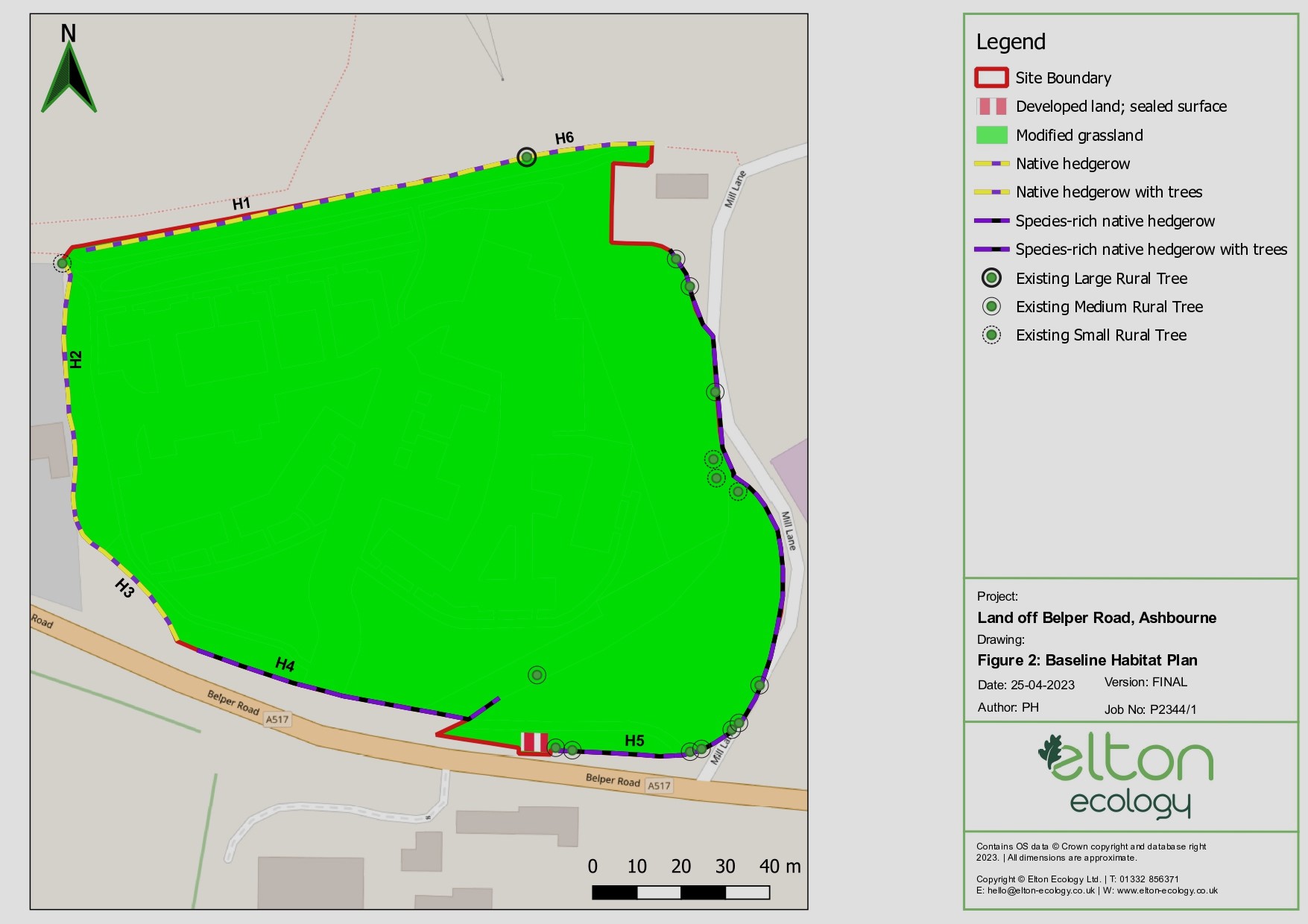
The UKHab Survey & Condition Assessment recorded the baseline existing habitat condition on site in relation to its optimal state; which included modified grassland, native hedgerows, and individual trees, from which the BNG calculation would be made. Via condition assessment of the baseline existing habitats on site, Elton Ecology were able to demonstrate the existing site to be of relatively poor habitat value, with significant scope to achieve a biodiversity net gain on-site post-development.
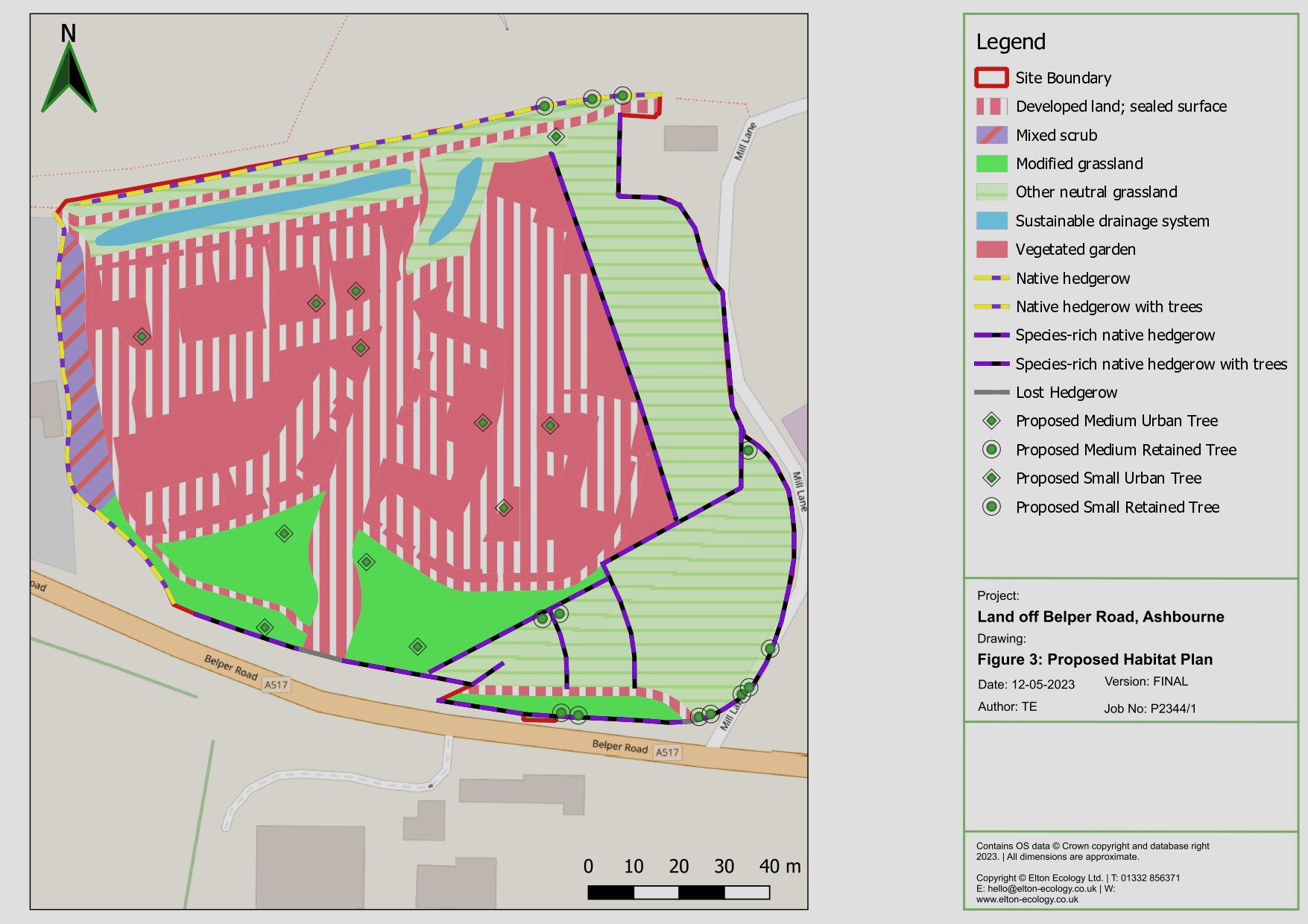
The UKHab and Condition Assessment survey data was then mapped via GIS and exported directly into the Biodiversity Metric spreadsheet, allowing for a fast workflow and accurate data migration. The Proposed site plans were also mapped in GIS and exported into the metric, applying professional judgement regarding the habitats to be created in the proposed scheme, in order to maximise the potential to deliver above 10% BNG on site. Post-development habitats included sustainable urban drainage systems, other neutral grassland wildflower meadow, species-rich native hedgerows, and tree planting.
Working as part of the design team, Elton Ecology delivered multiple drafts of the post-development habitat scheme, as the project proposals developed in accordance with other constraints and opportunities on site.
To assess the wider impacts on ecology and biodiversity, Elton Ecology Ltd also delivered:
- Ecological Impact Assessment (EcIA)
- Bat Transect Surveys
- Great Crested Newt (eDNA) Surveys
Outcome
Our Biodiversity Net Gain assessment demonstrated the proposed development could deliver a net gain of 17.36% in habitat units and 54.37% in hedgerow units.
The Ecological Impact Assessment report was able to conclude no significant impacts would arise from the proposed development, subject to the incorporation of mitigation measures.
Working as part of the design team for the site, Elton Ecology were able to design a scheme of habitat creation and enhancement which was compatible with other constraints and opportunities on site, and deliverable on the ground in the long term.
Impact
The Biodiversity Net Gain (BNG) proposals and our Ecological Impact Assessment (EcIA) were accepted by the Ecology & Biodiversity consultee on the planning application, who concluded that ‘The development has provided sufficient information for the Council to be reasonably confident that a net gain for biodiversity can be achieved on-site and that any impacts on protected species can be avoided or mitigated.’
The ecology consultee also commented that ‘We welcome Section 4 of the BNG Report, which clearly sets out how proposals have considered the mitigation hierarchy’.
Our work allowed an important local housing scheme to demonstrate compliance with planning policy and legislation requirements regarding ecology and biodiversity.
Elton Ecology Ltd have extensive experience in the end-to-end delivery of BNG for our clients, including surveys & reports supporting planning applications, to the design of long-term habit management post-development and discharge of conditions.